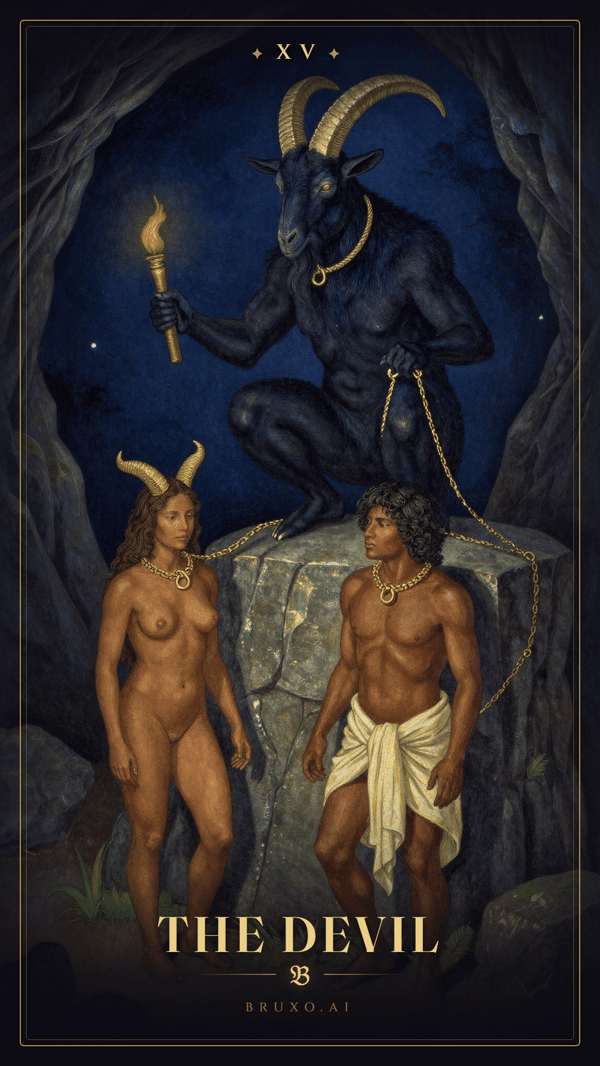
The Devil — Tarot Card Meaning
The Devil does not talk about evil. It talks about the tie you keep, and it hides one detail worth everything: the chain is loose, and your own hands can slip it.
✓ 60-day guarantee — if the Map tells you nothing of your own, full refund
The Map of the Draw
Three cards, drawn for your question. Read whole, by name. Turned into a plan with real dates. 24 pages. Yours to keep.
A private tarot reading: $60–120 · the Map at opening: $19
drawn one at a time — the bruxo reads each question alone, start to finish
You came through the cards' door — so the Map opens on your question first.
Get my Map — $13.40Secure checkout by ClickBank — card or PayPal. Your Map lands in your inbox within 24 hours.
Not medical or professional advice. For personal reflection and wellbeing. The cards are presented as declared tradition — a mirror, never a verdict or a prediction.
This is how a Map of the Draw is born
These are pages from a Map already drawn — someone else's question, with his name on it. Yours will speak of you: your cards, your plan, your ninety days.
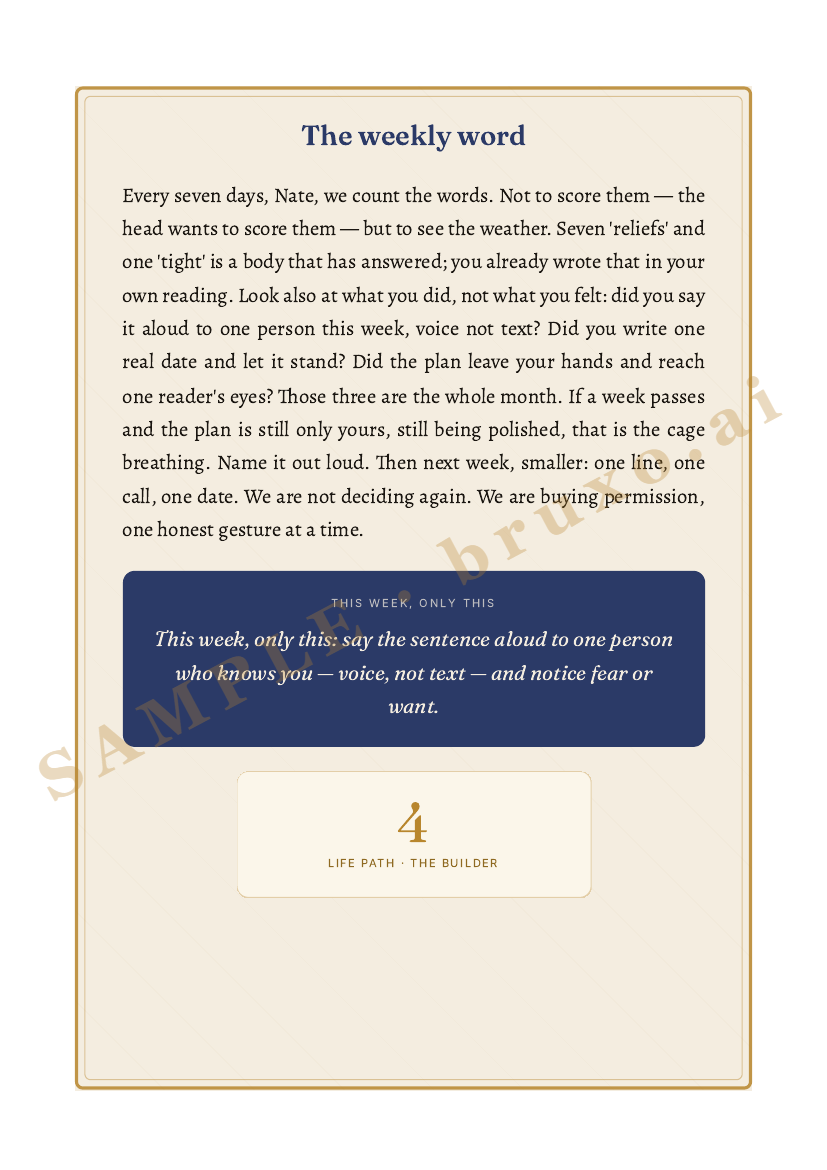 24 pages — yours will speak of you
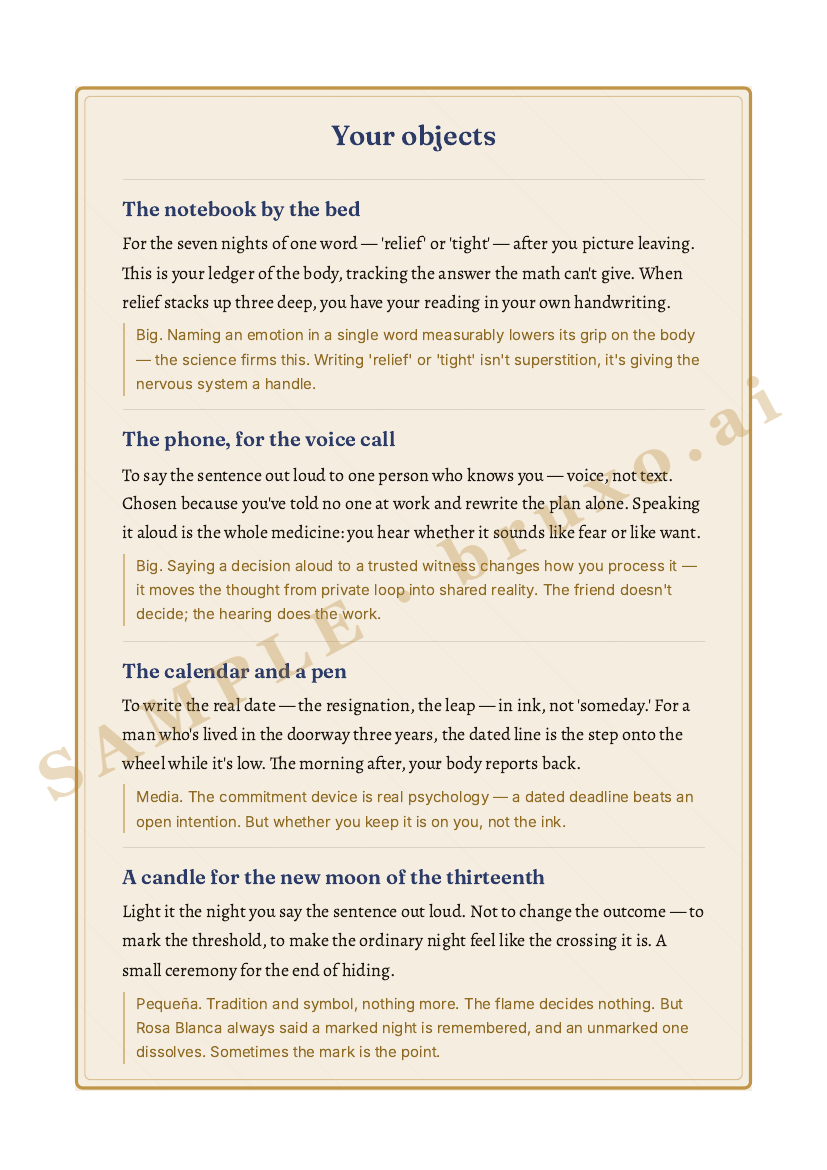 24 pages — yours will speak of you
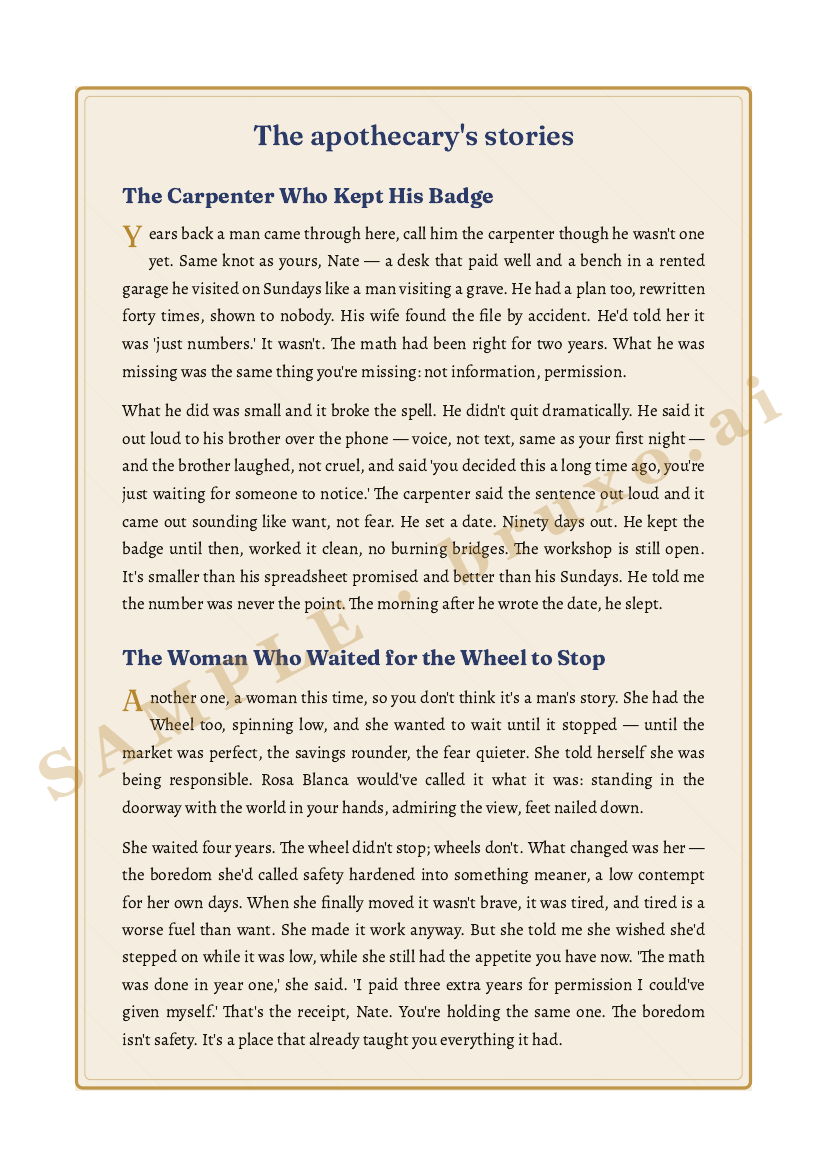 24 pages — yours will speak of you
Tap the first seven to look closer. The rest stay veiled: they belong to whoever ordered them.
The Devil upright: the loose chain
Nobody likes to pull this card. That's a shame. Of the twenty-two, this is the one that moves fastest when you read it straight. The Devil does not speak of evil, curses, or bad luck. It speaks of the tie you keep: the habit, the person whose messages you still open, the job you say you hate and never leave.
Look at the picture. Two people, chained by the neck. But the rings are wide. They slide right over the head. Nobody is locked in. That is the whole card. It does not judge you for staying. It only refuses the story where you have no part in it. While the story is "I can't get out," nothing moves. The moment it becomes "I'm not leaving, and there's a reason," everything can move. Reasons can be looked at.
The Devil reversed: the head slips free
Reversed, I read it as the first pull of fresh air. The chain is coming off. You saw the tie for what it is, and seeing is most of the work. But go slow here. Reversed does not mean you're free now. It means the door is open and your feet still remember the old room.
This is the week the old habit calls with its sweetest voice. Don't fight it head-on. Change the ground it stands on: take the app off the first screen, don't walk down that street, give the empty hour a new job. Small and physical beats big and brave. And if you slip back once, that's not the end of the story. It's one line in it.
The Devil in love
In love this card finds the tie nobody outside can explain. The one that ends and comes back. The one that hurts and is still too good on some days. The card does not say that love is evil. It says it's hard to put down, which is a different problem.
As long as the break-and-return keeps paying — the missing, the sweet reunion, the fire — no argument will end it. What ends it is mechanics: close the channel, ask a friend to hold your hand at 2 a.m., fill the trigger hour with something else. And one thing I say plain: if there is fear, control, or threats, that is not this card. That is danger, and the way out is practical and with real support, not symbols.
The Devil in work and money
At work, the Devil marks the false wall. A condition you treat as law — the salary, the city, what your father would say — that, held to the light, is a choice. I call it the golden collar. It pays enough to stay and costs enough to hurt.
Try this on paper. Write the three things you call non-negotiable in your job or your money. Then mark which ones are laws of physics and which are preferences you promoted to law. Under this card, one of them is almost always the loose chain.
With money, same song: the debt you keep feeding, the purchase that soothes a bad day. The card doesn't scold. It asks one question: what is this buying you? Name that, and you can shop for it cheaper.
When the Devil keeps appearing
When a card repeats, people fear a curse. There is none. A repeated card is a question you haven't answered yet, asked a little louder. The Devil comes back while the tie still pays and you still call it fate.
So sit with the ugly question: what does it give you? Not why it's bad — you know that by heart, and knowing never freed anyone. Relief? Company on a hard night? A self you know how to be? The answer is often embarrassing. Good. Embarrassing answers are the ones that work, because once the payment has a name, you can find another supplier. The card stops coming when the story changes hands — when "it holds me" becomes "I hold it."
How I read this card at my table
At my table this card gets a quiet voice, not a scary one. I set it down, I point at the rings, and I wait. Most people see it on their own: nobody in that picture is locked in. My grandmother Rosa Blanca used to say, "A knot you tied yourself already knows your hands."
I carried a tie of my own for years, saying I couldn't drop it. The day I wrote down what it gave me, it got obvious I could get that same thing cheaper somewhere else. Three weeks later it was done. Not because I got strong. Because it got clear.
So that's my read: this card is a mirror, not a sentence. It won't tell you what happens next. It shows you your own hand on the chain, and it leaves the move where it belongs — with you.
Habit research backs the old picture. A habit is a loop — cue, act, reward — and studies show that changing the cue and the setting works far better than resisting in the hot moment (Lally and colleagues, 2010, on habit formation). The "21 days" rule is a myth too: the real average runs much longer, and it varies a lot from person to person. Plain words: you are not weak. You've been fighting at the wrong hour. Move the fight to the cue — the shortcut, the street, the empty hour — and the odds change.
An old story — legend, not record — says the Devil once bragged he could hold any soul with a single chain. A blacksmith's widow asked to see hers. He showed her a chain so loose it slid over her head like a necklace. "Then why do they stay?" she asked. "Because," he said, "not one of them has ever looked down." The old readers kept that tale with card fifteen. Not to scare anyone. To make them look down.
Questions that reach the apothecary
What does the Devil tarot card mean?
Is the Devil a bad card to pull?
What does the Devil mean in love?
So now you know what The Devil points at: the chain you could lift off any time — and the reasons you keep calling it a necklace.
But one card is a mirror; the draw is the conversation. Bringing your own question to the table — the full spread read around it, start to finish — is the Map of the Draw: 24 pages read on your question alone, yours for good.
The card has spoken. The conversation is still waiting.
Open my Map — $13.40Secure checkout by ClickBank · 60-day guarantee · no rush: the apothecary door doesn’t close.