Herbs to lower cortisol: which ones actually work?
No herb switches cortisol off — you would never wake up. Some do soften the evening spike. The test tells you which fits your night.

Updated Jul 10, 2026
✓ 60-day guarantee — if the Map tells you nothing of your own, full refund
What's your rhythm? Find your archetype
The Natal Map of the Body
It finds your weak hour — and why. It tells you what holds each season. 26 pages. Your name on every one.
Your Map marks YOUR hours — when your tide rises and when to bring it down. It's not the generic line on this page: it's yours, drawn from your chronotype and your moment, with the ritual gestures ordered hour by hour. 26 pages, yours forever.
One astrology + naturopathy consultation: $80–150 · the Map at opening: $19
forged one at a time — the bruxo writes each Map alone, start to finish
You came through the remedies door — so the Map opens on your nights first, herb by herb.
Get my Map — $13.40Secure checkout by ClickBank — card or PayPal. Your Map lands in your inbox within 24 hours.
Not medical advice. We do not measure or treat cortisol. This page is for reflection and personal wellbeing. Astrology is presented as declared tradition — never as science.
This is how a Map is born
These are pages from a Map already forged — someone else's, with their name on it. Yours will speak of you: your hours, your body, your seasons.
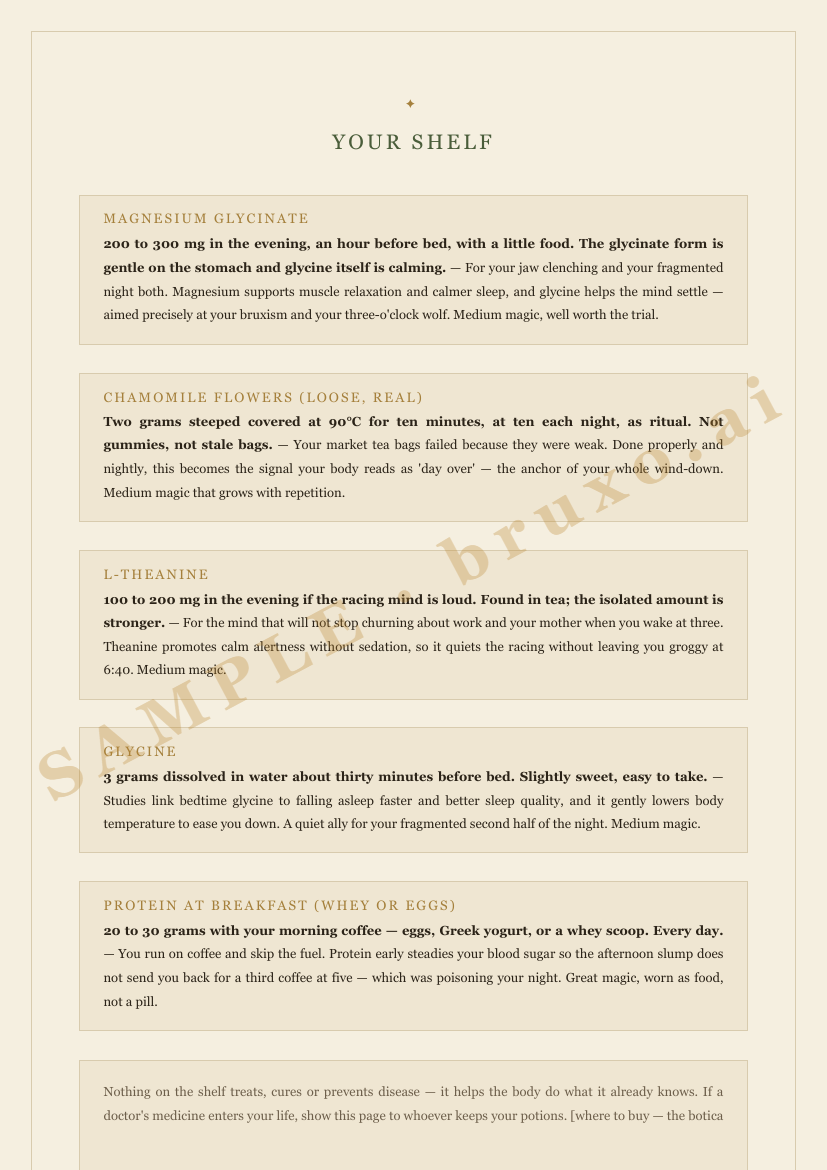 26 pages — yours will speak of you
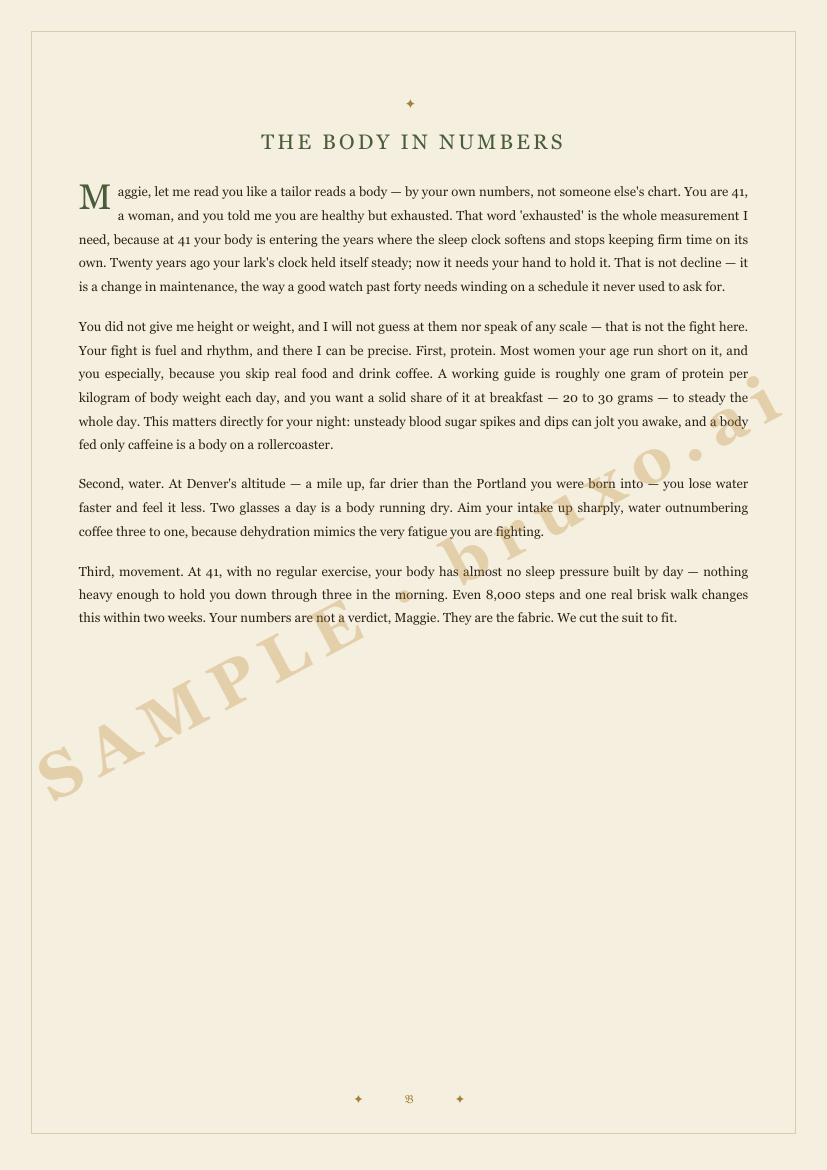 26 pages — yours will speak of you
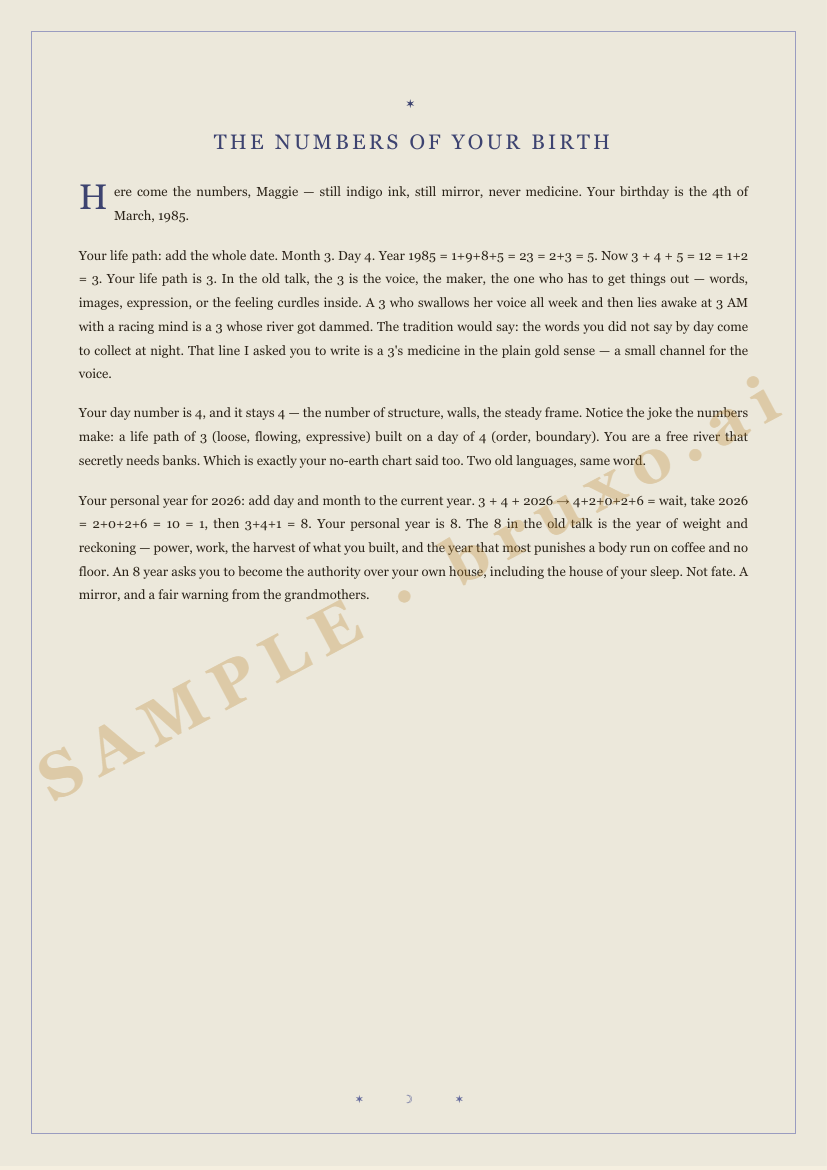 26 pages — yours will speak of you
Tap the first two to look closer. The rest stay veiled: they belong to whoever ordered them.
Cortisol isn't the villain. It's a rhythm. It rises sharply when you wake — that morning push is health, not sickness — and falls through the day to nearly zero at night, so you can sleep. The problem is never "having cortisol": the problem is when the rhythm flips — flat in the morning, switched on at eleven at night. So the right question isn't "which herb lowers it?" but "what supports my rhythm so it rises when it should and falls when it should?".
I'll tell you straight, because almost nobody does: if someone sells you something that "lowers cortisol," they're lying twice. First, because lowering it at any hour isn't desirable — the morning peak is your fuel. Second, because no herb has been shown to "switch off" this hormone on command. What does exist: a handful of herbs with serious clinical trials where people who took them reported less perceived tension than those on placebo. Far less glamorous than a "detox" — and it's the only honest thing you can say.
We don't measure or treat your cortisol. What we do here is different: we tell you what the trials found (in the third person, inventing no promises) and give you a map of hours to support your natural rhythm — support the moments of tension, honor the night's plateau. The difference between "fixing" and "supporting" is the whole difference.
Cortisol follows a circadian rhythm: a peak 30-45 minutes after waking (the "cortisol awakening response") and a decline to its low near midnight. A flattened or reversed rhythm — not a "high" level as such — is what research links to worse sleep and fatigue. (review of the cortisol awakening response, Stalder et al., 2016)
Grandmothers across half the world said the first morning light "lights the body," and that night asks for shadow so the soul can gather itself in. That's not a lab result — it's tradition talking. But it looks a lot like what science calls "the rhythm."
Tired but wired at eleven at night
You know the scene. All day dragging your feet, yawning in meetings, dreaming of bed. Then it hits 11 p.m. and — suddenly — the head switches on. The body begs for sleep; the mind signs imaginary emails. There's a name for it: tired but wired — exhausted and switched on at the same time. It's the signature of a rhythm that flipped.
And what did you do? The usual. The 4 p.m. coffee "to push through." The 1 a.m. scroll "to switch off." You tried chamomile, the meditation app, sleeping in socks. Nothing held, because you were fighting the symptom in the dark, without looking at the clock. Cortisol keeps a schedule — and you were fighting it off-schedule.
And then the noise. You open TikTok and there are fifty "cortisol detox" videos, "cortisol face," shakes that "reset your hormones in three days." It's smoke with good lighting. Cortisol can't be "detoxed" — it isn't garbage, it's a hormone your body makes on purpose. The missing piece isn't another list of tips or a miracle bottle: it's knowing what hour to do each gesture. Working your rhythm by schedule, not by trend.
The 24-hour line: your rhythm, hour by hour
Here's the map. Six moments of the day, each with a gesture that supports the rise or fall of your natural rhythm. The gold has a scientific source; the indigo is declared ritual — tradition that helps mark the ceremony, without pretending to be a lab.
Light and protein. Get to a window or outside within the first 30-60 minutes. Morning light in your eyes is the strongest signal for your rhythm to rise on time. Add protein to breakfast instead of just sugar: it holds your energy without the mid-morning crash.
Ride the high tide. Here your rhythm is naturally at its highest — it's your best window for the task that takes a clear head. Don't waste it on email. And don't panic: feeling alert and focused at this hour is exactly what should happen.
Last cup, and make it early. Caffeine takes hours to clear: half of it is still in you 5-6 hours later. A 4 p.m. coffee is still circling at midnight. Cut caffeine at least 8 hours before your bedtime.
Move the body, don't wreck it. A walk, easy cycling, moderate strength: evening exercise helps the day's tension drain and the night arrive deeper. Avoid a maximum workout right up against bed — for many people it lights them up instead of powering down.
Here the remedy comes in, if it fits your case. This is the window to support the plateau with a declared gesture: a cup of linden or lavender tea, or — with your doctor's green light — the ashwagandha extract the trials study. It's not instant magic: it's a signal you give the body that the day is closing.
Switch off the screens, switch on the notebook. Dim the lights an hour before bed; the shadow lets melatonin rise. And if your head won't stop, write: three lines of what's circling, by hand. Getting it out of your head and onto paper loosens the "tired but wired" knot.
The herbs, one by one — with their ink
Here's the part almost nobody gives you straight: how much real evidence each herb has. We mark each card with its grade of "magic": big gold = serious trials; medium green = moderate or young evidence; smoke = they're selling you air. Remember: we're talking about perceived tension and what those studies measured — we don't promise any number will drop for you.
Ashwagandha
The most studied of the group. In trials with stressed adults, those who took the extract for 60 days reported lower stress on the scales and showed lower cortisol readings than placebo. That's what those studies measured, not a promise.
Rhodiola
Studied mostly for stress-linked fatigue and burnout. Several small trials saw improvements in tiredness and focus; quality is uneven and larger studies are needed.
Green tea / L-theanine
L-theanine, the amino acid in tea, has trials showing a focused calm — relaxation without drowsiness. Good for the afternoon window. Green tea also carries caffeine, so mind the hour.
Lavender
Both as a standardized oral capsule and as aroma, lavender has trials reporting less perceived anxiety and better rest. Decent evidence for the night's wind-down ritual.
Tulsi / holy basil
A pillar of the Ayurvedic tradition. Preliminary human studies suggest improvements in stress and mood, but they're small and of mixed quality. Promising and young: keep watching.
Magnolia
Its compounds (honokiol, magnolol) are studied for relaxing effects. There are interesting signals in small trials, especially in combination, but the evidence on its own is still thin.
What gets sold under neon light and can't survive a single question. If you see this, close the tab:
- "Cortisol detox." Cortisol isn't a toxin. There's nothing to "detox." No trial backs the phrase.
- Crystals, bracelets, and the "cortisol chakra." Pretty as decoration; zero effect on a hormone.
- Multi-herb blends with undeclared doses. If the bottle lists a "proprietary blend" and won't say how many milligrams of each thing, you can't know there's a useful dose. There almost never is.
- "Lowers cortisol in 3 days." The serious trials measured 60 days. Any express promise is marketing, not biology.
- "Cortisol face" and puffiness cures. A social-media term, not a diagnosis. Selling a cream against it is selling smoke.
I took ashwagandha one whole winter, same hour, with tea. Did it "lower my cortisol"? I have no idea — I didn't prick my blood every night, and anyone who tells you they know without measuring is lying. What I did notice: the ceremony. Sitting at the same hour, killing the lights, closing the day. Maybe half the effect was the habit and not the root. And you know what? I don't care. Habit is medicine too.— the bruxo, of the apothecary
What moves more than any herb
Here's the truth that sells no bottles: the free gestures outweigh any capsule. If you could only do four things for your rhythm, it would be these — and every one has more backing than the best herb on the list.
| Gesture | What it does | Strength |
|---|---|---|
| Sleep at a fixed hour | Going to bed and rising at the same time anchors the whole rhythm. The master lever. | Strong |
| Morning light | 30-60 min of outdoor light early lifts the rhythm on time and advances the night. | Strong |
| Cut caffeine 8 h before | Clears the stimulant before sleep; you notice it within days. | Strong |
| Regular exercise | Drains the day's tension and deepens sleep; better not in the last hour. | Strong |
Sources for this table: sleep regularity and morning light (Blume 2019), caffeine (Drake 2013), exercise and sleep (Kredlow 2015).
When this belongs to the doctor, not the apothecary
Clinical cortisol is real, and when it truly goes off it's serious — not a matter of tea. No herb or app replaces a doctor. See one if any of this shows up:
- Extreme fatigue that doesn't ease with rest, weeks on end.
- Unexplained weight changes (up or down with no reason), a rounded face, easy bruising.
- New high blood pressure, sharply increased thirst or urination.
- You're pregnant, breastfeeding, on chronic medication, or have thyroid disease — before any herb.
Conditions like Cushing's syndrome or adrenal insufficiency are diagnosed with lab tests, not an internet quiz. If anything on the list rings true, that's the door: the clinic, not the supplement shop.
My job is to keep company with your nights, not to play doctor. If your body is doing strange things — the weight, the face, the pressure — don't stay with the bruxo: go to the doctor. I'll be here afterward, for the ritual part. The doctor is the spine of the remedy; I'm only the leaf.— the bruxo, of the apothecary
Questions that reach the apothecary
What herbs lower cortisol?
Does ashwagandha lower cortisol?
How long do herbs take to work for stress?
Can I take stress herbs if I'm on medication or pregnant?
Does the TikTok "cortisol detox" work?
From the same shelf
- Why you wake up at 3 a.m. (and the body-organ clock)
- Tired but wired: why you're exhausted and switched on at once
- Tea for sleep: 7 infusions and what the evidence says
- Birth chart calculator — the starting point of your Map
So now you know which herbs the tradition uses to talk cortisol down — and when in the day each one earns its place.
But a page like this can only speak in general — it describes the night, not yours. Which hours run strong in your own body, which remedy fits your constitution — that reading starts from your birth data, and it is the Map of the Body: 26 pages written on your chart alone, yours for good.
The night has been explained. Yours is still waiting to be read.
Open my Map — $13.40Secure checkout by ClickBank · 60-day guarantee · no rush: the apothecary door doesn’t close.