Melatonin vs Magnesium for Sleep: Which One Is Right for You?
They do not compete: melatonin is a clock signal, magnesium is a relaxation mineral. Which one your night needs — that is the test.
The bruxo has no bottles to sell you — only the truth about each potion.

Updated Jul 10, 2026
✓ 60-day guarantee — if the Map tells you nothing of your own, full refund
Which potion fits your night? Six questions.
The Natal Map of the Body
It finds your weak hour — and why. It tells you what holds each season. 26 pages. Your name on every one.
The quiz gives you the archetype. The Map draws the whole night: your complete evening protocol with your hours — your wind-down window, your light schedule, which potions fit your type of night and which to skip — plus your chronotype and your energy hours by season. 26 pages. Yours forever.
An astrology + naturopathy consultation runs $80–150 · the Map at opening: $19
forged one at a time — the bruxo writes each Map alone, start to finish
You came through the remedies door — so the Map opens on your nights first, herb by herb.
Get my Map — $13.40Secure checkout by ClickBank — card or PayPal. Your Map lands in your inbox within 24 hours.
Not medical advice. For reflection and personal well-being. These statements have not been evaluated by the FDA; no product or reading is intended to diagnose, treat, cure or prevent any disease. Astrology is presented as declared tradition — never as science.
This is how a Map is born
These are pages from a Map already forged — someone else's, with their name on it. Yours will speak of you: your hours, your body, your seasons.
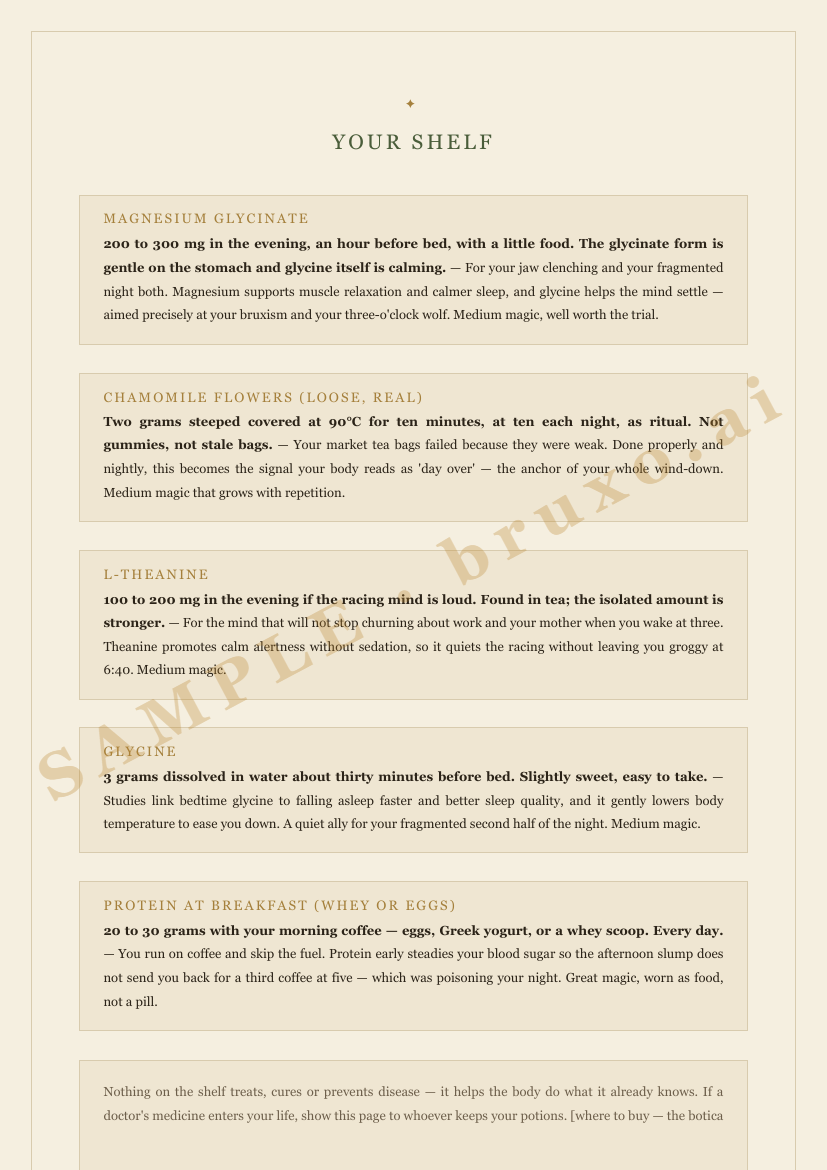 26 pages — yours will speak of you
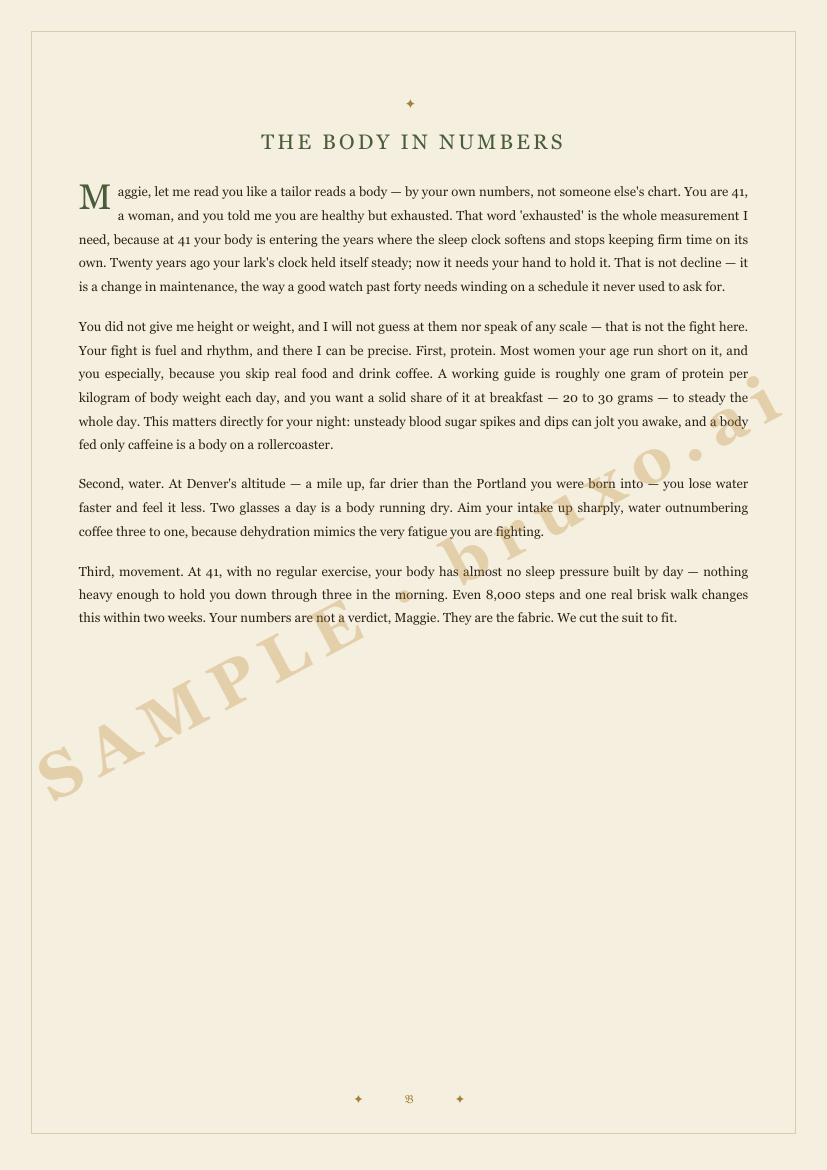 26 pages — yours will speak of you
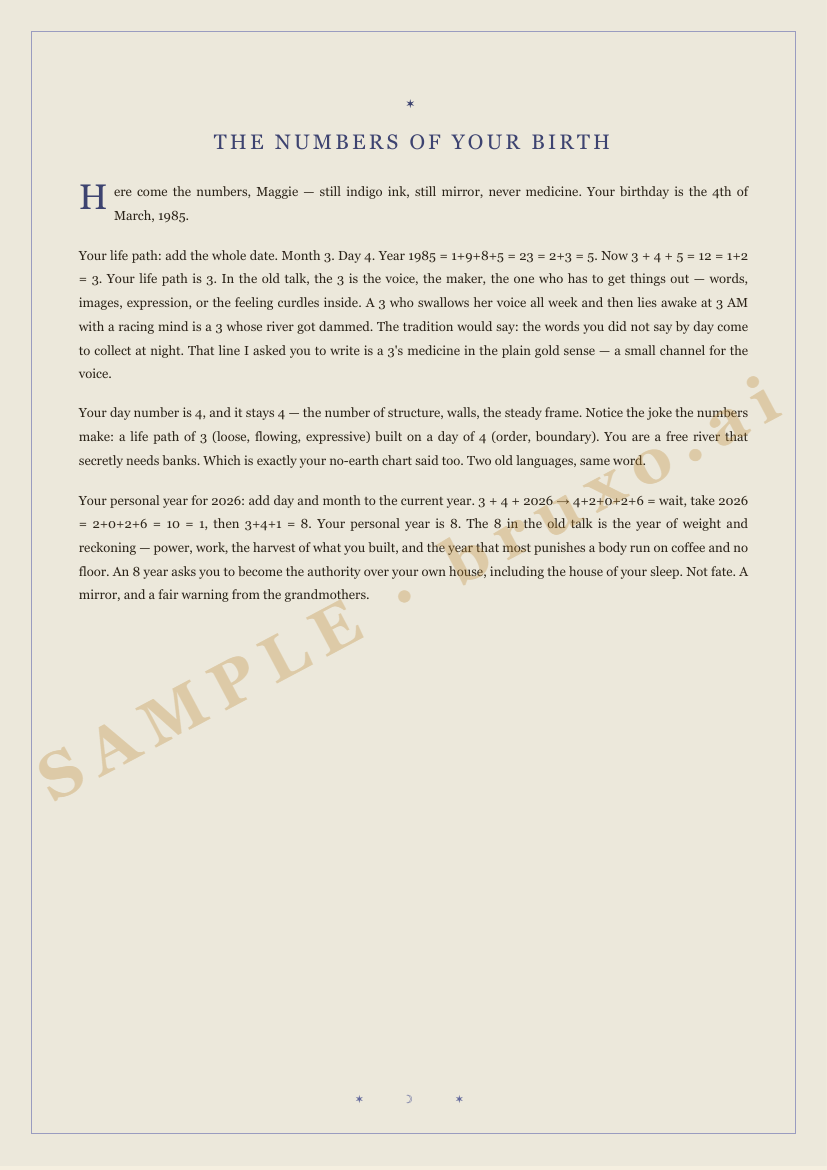 26 pages — yours will speak of you
Tap the first two to look closer. The rest stay veiled: they belong to whoever ordered them.
If you remember one thing from this page, make it this: melatonin works on the when of sleep, magnesium works on the how. Melatonin is what scientists call a chronobiotic — its real power is moving your body clock. That's why it shines for jet lag, night-shift recovery, and the person whose body simply refuses to feel sleepy before 2 a.m. As a knockout drop, it's weak: on average it helps people fall asleep only about seven minutes faster.
Magnesium doesn't knock you out at all. It's a mineral your body uses in more than 300 reactions, including the ones that let muscles release and the nervous system settle. When your intake is low — which is common with modern diets — topping it up can support calmer, better-quality nights. When your levels are already fine, an extra capsule usually changes very little. That's the honest version.
So the question was never "which one is stronger?" They solve different problems. A shifted clock is a melatonin-shaped problem. A tense, depleted body is a magnesium-shaped problem. And some of the most stubborn nights are neither — they're a screen, a coffee, or a worry wearing a pillow. This page will help you tell them apart.
A meta-analysis of 19 placebo-controlled studies found melatonin helped people fall asleep about 7 minutes faster and sleep about 8 minutes longer on average — real, but modest. Its best-documented strength is shifting the timing of sleep, not deepening it. (Ferracioli-Oda et al., 2013, PLoS ONE)
In a double-blind randomized trial in adults over 60, 8 weeks of magnesium (500 mg/day) improved measures of sleep quality — time to fall asleep, time asleep, early waking — versus placebo, in a group likely to be low in magnesium to begin with. (Abbasi et al., 2012, J Res Med Sci)
The old apothecaries said the night keeps two servants: one carries the lantern that dims the world at the proper hour, and one loosens the knots the day has tied into the body. The legend never confused the two. Neither should you.
11:47 p.m., two bottles, zero clarity
You know the scene. The pharmacy aisle — or its glowing online version — at almost midnight. On the left, melatonin: "fall asleep naturally." On the right, magnesium: "calm and restful nights." Both labels smiling. Both reviews glowing. And you, tired enough to buy both and trust neither.
Maybe you already tried one. Maybe you took melatonin — a big 10 mg gummy at whatever hour — and woke up foggy, dreams like bad television, and decided "it doesn't work on me." Or you grabbed the cheapest magnesium at the supermarket — oxide, almost always — and the only thing it moved was your gut. None of that means the potions failed. It very often means you took the other person's remedy: the right answer to somebody else's night.
The missing piece isn't a stronger capsule or another list of ten tips. It's knowing what kind of night you actually have — a clock problem, a body problem, both, or neither. That takes 30 seconds to find out.
What melatonin actually is (and what it isn't)
Melatonin is a hormone your own brain makes every evening, when light fades. It isn't a sedative — it's a signal. It tells every clock in your body: "night has begun." Taken as a supplement, it works best exactly there: not by forcing sleep, but by moving the hour at which your body expects sleep.
That's why the strongest evidence for melatonin is in clock problems: jet lag after crossing time zones, and the "delayed phase" pattern — the person who can't feel sleepy before 1 or 2 a.m. no matter how early they get in bed, then can't wake for work. For plain "I sleep badly," its effect is real but small: those seven minutes from the golden ink above.
A Cochrane systematic review found melatonin "remarkably effective" at preventing or reducing jet lag when timed correctly for eastward travel across five or more time zones. Timing was the whole trick: the same pill at the wrong hour can shift the clock the wrong way. (Herxheimer & Petrie, Cochrane Database Syst Rev, 2002)
Now the dose myth. Stores mostly sell 5 and 10 mg — because bigger numbers look stronger on a shelf. But research keeps finding that low doses, around 0.5 to 1 mg, are enough to signal the clock; more melatonin is not more sleep, it's mostly more morning grogginess and stranger dreams. If melatonin "didn't work" for you, the fix is almost never a bigger dose. It's a better hour — usually 30 to 60 minutes before the bedtime you want, kept at the same time every night.
I keep melatonin in the smallest drawer of the botica. Not because it's weak — because people swing it like a hammer when it's a clock key. Half of those who tell me "it did nothing" were taking it at midnight to fix a 3 a.m. waking. Wrong spell, wrong door. And I'll say what a seller can't: some nights break for reasons I don't know. Those I send to a doctor, not to a bottle.— the bruxo, from the apothecary
What magnesium actually does for your nights
Magnesium is not a sleep drug, and anyone selling it as one is stretching. It's a mineral involved in over 300 of your body's reactions — including the ones that let a contracted muscle release and the ones that keep the nervous system's "brake" working. Your body can't make it; it has to arrive on the fork.
Here's the honest mechanism: if your intake is low — common with diets built on processed food, and more common as we age — bringing it back up can support muscle relaxation and calmer, less broken nights. If your levels are already fine, an extra capsule is unlikely to change much. Magnesium fixes a shortage, not a bedtime.
Clues that your body may be running low: night calf cramps, that eyelid that twitches for days, muscles that stay tense even in bed. None of these is proof — but together with a diet low in greens, nuts and whole grains, they make magnesium worth a try.
Honesty in gold: a 2021 systematic review of magnesium trials for insomnia in older adults found a modest benefit — falling asleep roughly 17 minutes faster — but rated the overall quality of evidence as low. Promising, cheap, safe for most; not a miracle. (Mah & Pitre, 2021, BMC Complement Med Ther)
Folk healers called magnesium-rich waters "the baths that untie." People traveled to bitter springs to soak the day out of their shoulders. It's a lovely story — and it is a story. The measurable part today is the mineral, not the pilgrimage.
Side by side: the honest table
| Melatonin | Magnesium | |
|---|---|---|
| What it does | Signals "night" to your body clock; shifts sleep timing. Mild effect on falling asleep (~7 min). | Supports muscle relaxation and nervous-system balance; helps sleep quality mainly when intake is low. |
| When it makes sense | Jet lag; shift-work transitions; a body clock stuck too late; the problem is entering sleep at a decent hour. | Tension, cramps, eyelid twitches; diet low in greens/nuts; older adults; the problem is a body that won't settle. |
| When it doesn't | Waking at 3 a.m. with a stable schedule; using big doses as a nightly knockout; pregnancy or nursing without a doctor. | Kidney problems (door closed — doctor first); expecting a sedative effect on night one; already-good magnesium status. |
| Typical dose | 0.5–1 mg, 30–60 min before the bedtime you want. Timing beats milligrams. | 200–400 mg elemental, with dinner or before bed. Glycinate is the usual night form. |
| How long until you notice | Timing effects from the first nights; re-setting the clock takes days of consistency. | Days to weeks. It's repletion, not sedation. |
| Side effects | Morning grogginess, vivid dreams, headache — mostly at higher doses. | Loose stools and stomach upset (especially citrate and oxide). |
| Key interactions | Blood thinners (anticoagulants), immunosuppressants, diabetes medication; avoid in pregnancy/nursing unless a doctor agrees. | Quinolone and tetracycline antibiotics (separate doses by hours), bisphosphonates; caution with reduced kidney function. |
Read that last row twice if you take anything daily. Neither of these is "just a vitamin": both have doors they shouldn't walk through, and your pharmacist or doctor holds those keys.
The forms of magnesium, in one minute
Glycinate — magnesium bound to glycine. Gentle on the stomach, well absorbed, the usual evening choice. Citrate — well absorbed, but pulls water into the gut; helpful if you're also constipated, inconvenient if you're not. Oxide — the cheapest and the one in most supermarket bottles; poorly absorbed, mostly a laxative wearing a sleep label. One label trick: look for the elemental magnesium amount, not the compound weight.
Forms, doses and the full decision tree live here: which magnesium for sleep — glycinate, citrate and oxide, compared.
What neither of them fixes
This is the part the brands that rank above this page tend to skip, because they have a bottle waiting at the bottom. We don't. So, plainly — no capsule on Earth out-argues these four:
- The lit screen at midnight. Bright light is the strongest "it's daytime" signal your brain knows. It suppresses your own melatonin — the one you make for free. A supplement whispers; your ceiling light shouts.
- The 5 p.m. coffee. Caffeine can sit in your system six hours or more. If you're wired at midnight, the potion you need might be "no caffeine after 2 p.m." — it costs nothing.
- The nightcap. Alcohol gets you to sleep faster and then breaks the second half of the night into pieces. If you wake at 3 a.m. after evening drinks, start there — and read what waking at 3 a.m. means.
- Tomorrow's meeting. No mineral erases a racing mind. Stress needs its own tools — breath, paper, a talk — not a bigger dose.
If a page tells you a capsule beats those four, that page is selling the capsule. This one has nothing to sell you tonight.
People come asking for my strongest potion. I ask what time they last looked at their phone. There is no herb in my botica taller than a lit screen at midnight, and no mineral heavier than a coffee at five in the afternoon. Fix the light and the coffee first. Then, if a potion is still needed — at least it will be the right one.— the bruxo, from the apothecary
When this stops being potion territory
Some doors the bruxo does not open, and says so out loud. Go to a doctor — not a supplement aisle — if any of these is true: you snore loudly or wake gasping (that's worth a sleep-apnea check); daytime sleepiness is affecting your driving or work; your nights have been broken for months despite decent habits; low mood or anxiety came as a package with the bad sleep; you're pregnant or nursing; it's for a child or teenager; or you take daily medication and haven't cleared interactions. Structure and function is our lane: these potions can support a good night. They do not treat, cure or prevent any condition — and pretending otherwise is how people lose months. The doctor is the spine of the remedy.
Why there are no testimonials here
Most pages in this fight end with five smiling strangers who "finally sleep like babies." We won't do that, for a simple reason: we haven't earned them yet, and we refuse to invent them. Here's what we offer instead, as the house credo:
- We sell neither bottle. Not melatonin, not magnesium, not a "proprietary blend." No affiliate links either. That's why this page can afford to tell you when the answer is "neither."
- Two inks, never mixed. Everything in gold is science with a named, linked source. Everything in indigo is legend, declared as legend. If we're not sure, we say so.
- Real letters only. When readers write back with results and give permission, their words will appear here — with dates, unedited. Until then, this space stays honest and empty.
Questions that reach the apothecary
Can I take melatonin and magnesium together?
Which is better for waking up at 3 a.m.?
How much melatonin should I take?
Is it safe to take melatonin every night?
Which form of magnesium is best for sleep?
From the same shelf
- Which magnesium for sleep? Glycinate, citrate and oxide, compared
- Tea for sleep: the seven herbs of the apothecary
- Waking up at 3 a.m.: what it means, hour by hour
- Birth chart calculator: draw the map of your body
So now you know the difference: melatonin speaks to the clock, magnesium speaks to the body — and which one your night was actually asking for.
But a page like this can only speak in general — it describes the night, not yours. Which hours run strong in your own body, which remedy fits your constitution — that reading starts from your birth data, and it is the Map of the Body: 26 pages written on your chart alone, yours for good.
The night has been explained. Yours is still waiting to be read.
Open my Map — $13.40Secure checkout by ClickBank · 60-day guarantee · no rush: the apothecary door doesn’t close.