Rising sign calculator
The sign rising on the horizon the minute you were born — it moves one degree every four minutes, so the hour matters.

Updated 25 Jul 2026
✓ 60-day guarantee — if the Map tells you nothing of your own, full refund
Calculate your rising sign now
Honest note: we use the standard time of the city you pick. If you were born during daylight saving time, the result can shift — the full Map calculates it finely.
☾ Read in the astrological tradition — a mirror for reflection, not science.
The Map of the Sky
Your Sun, your Moon, your rising — read as one story, not three parts. 28 pages. Your name on every one.
The book of your body: chronotype, your strong and weak hours, rest by season — calculated from your exact positions. 26 pages, yours forever.
An astrology consultation: $80–150 · the Map at opening: $19
forged one at a time — the bruxo writes each Map alone, start to finish
You came through the birth chart door — so the Map opens on your sky first.
Get my Map — $13.40Secure checkout by ClickBank — card or PayPal. Your Map lands in your inbox within 24 hours.
Not medical advice. For personal reflection and wellbeing. Astrology appears here as declared tradition — never as science.
This is how a Map is born
These are pages from a Map already forged — someone else's, with their name on top. Yours will speak about you: your hours, your body, your seasons.
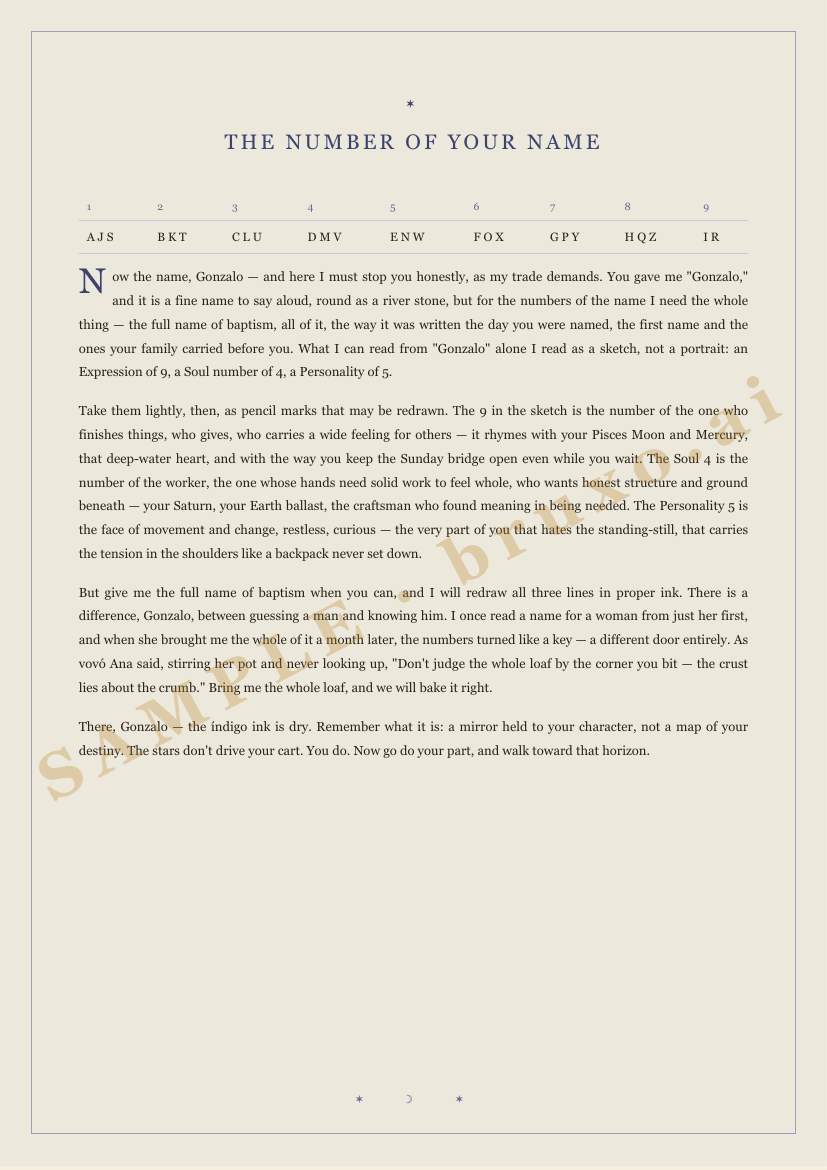 28 pages — yours will speak of you
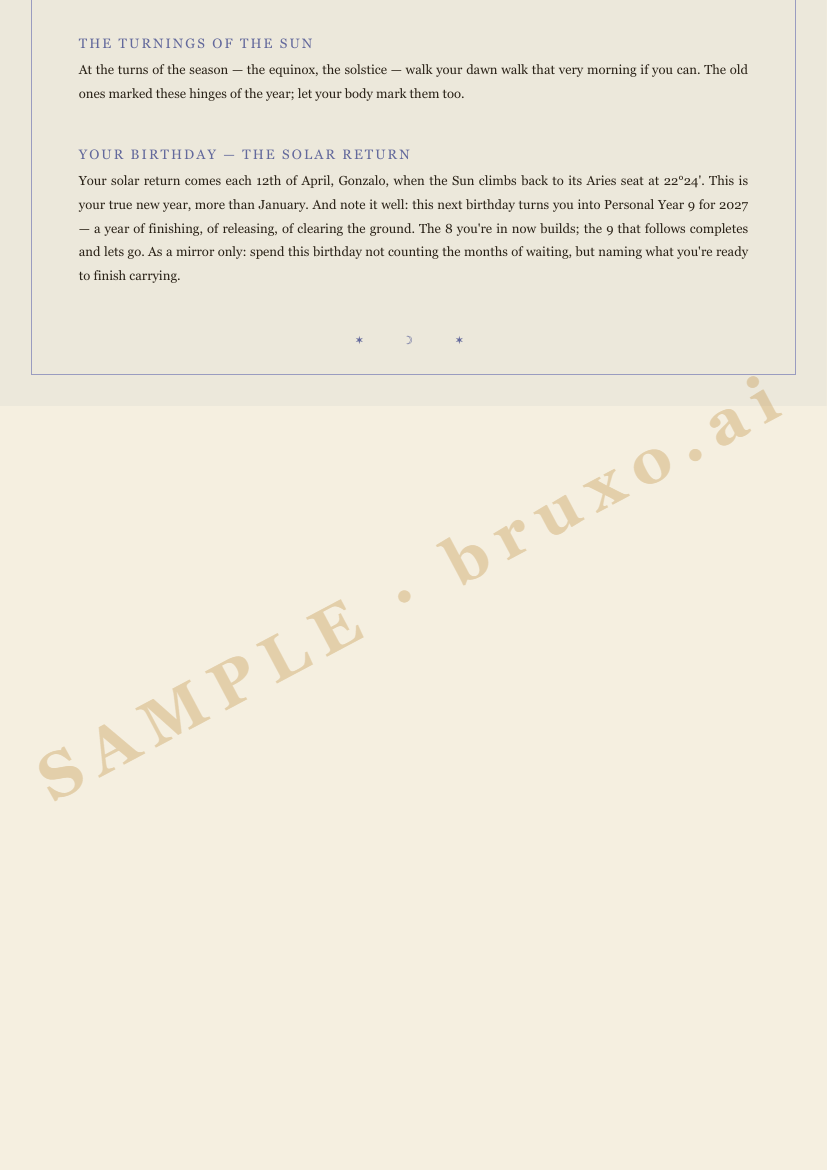 28 pages — yours will speak of you
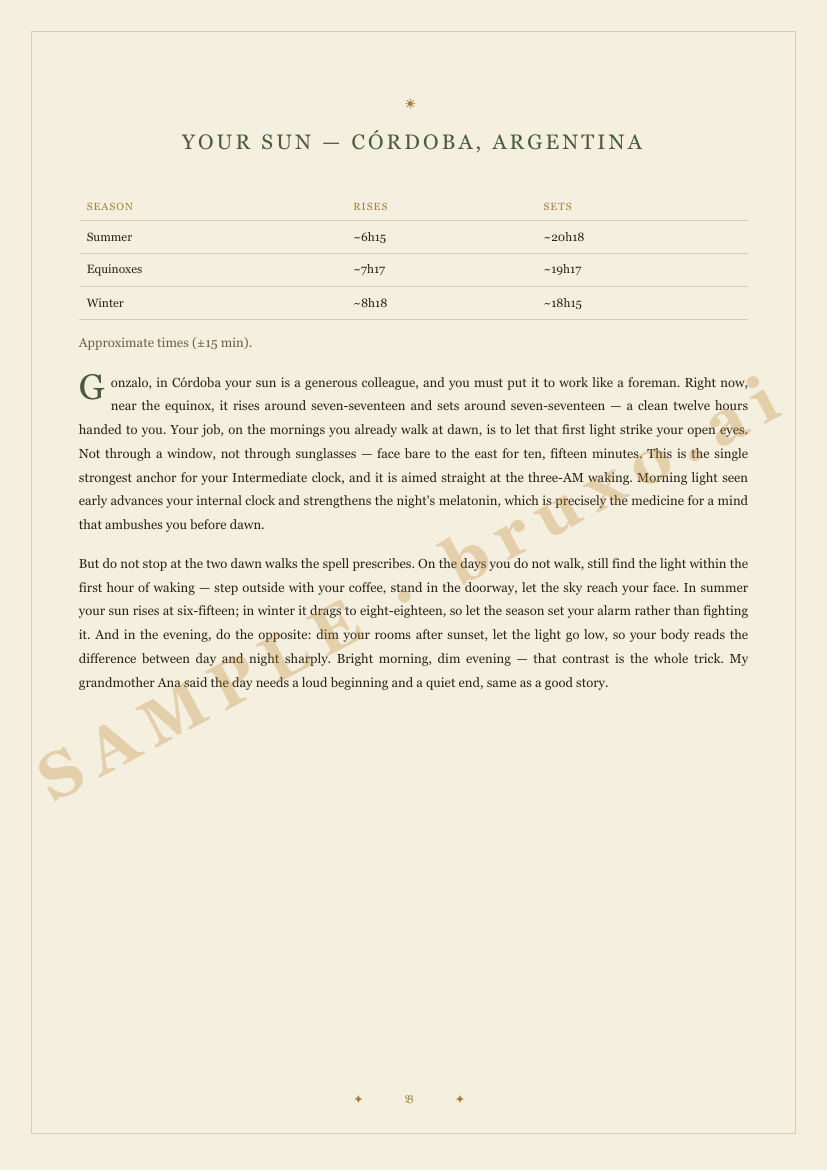 28 pages — yours will speak of you
Tap the first seven to see them up close — the calendar included. The others stay veiled: they belong to the person who commissioned them.
What the rising sign is, and why it isn't your sign
Your rising sign — the ascendant — is the degree of the zodiac that was climbing over the eastern horizon at the exact minute and place you were born. Your sun sign depends on the date: it's identical for everyone born that day anywhere on the planet. The ascendant depends on the hour and on the point of the Earth you were standing on: it's the only part of the chart that two people born the same day, in the same city, twenty minutes apart, no longer share.
That's why, in the tradition, the ascendant doesn't describe what you are on the inside but how you walk in: the first impression, the automatic gesture, the face you make before you've decided anything. It's the door, not the house. Confusing it with the sun sign is the most common misunderstanding in the craft, and the reason so many people feel their horoscope never quite fit.
Ancient astrology called the ascendant the horoscopus — literally “the hour-watcher”. That's where the word horoscope comes from: originally not a magazine column but this, the point of the sky that surfaced at your hour. Hellenistic treatises treated it as the rudder of the chart. It is declared tradition, old and beautiful, and it is not science.
The arithmetic underneath is verifiable astronomy: the Earth turns once on its axis every 23 h 56 min, and that rotation is what lifts a fresh degree of the zodiac over the horizon every four minutes. This page computes it from local sidereal time and the obliquity of the ecliptic — the same mathematics used to aim telescopes. (ephemerides — U.S. Naval Observatory)
What you need to calculate your ascendant
- The time, as exact as you can get it. In the US and the UK it's usually on the birth certificate or in the hospital record. It's worth digging out the paper instead of guessing: “around five” can be two different ascendants.
- The city. The horizon isn't the same in London as in Los Angeles: at the same universal hour, a different sky is rising. If your city isn't on the list, type latitude, longitude and offset by hand.
- The full date. Day, month and year — without it there's no sky to compute.
If you don't have the time, this calculator will not invent a sign for you. It says so, and points you to what can honestly be known from the date alone: your moon sign and the moon phase of your birth. We'd rather give you a truthful “I don't know” than a pretty, false result.
Why four minutes change the answer
Do the arithmetic with us: 360 degrees of zodiac divided by 24 hours of rotation is 15 degrees an hour — one degree every four minutes. Since each sign spans 30 degrees, the ascendant changes sign roughly every two hours, faster or slower depending on latitude, because near the poles some signs rise almost at once while others take their time.
That explains two things people ask constantly. First: why two siblings born the same day can wear such different faces in the chart. Second: why daylight saving time ruins so many calculations. If the clock on the wall was running an hour ahead of the real sun and nobody wrote it down, the ascendant you get belongs to a stranger two houses down the street, not to you.
I've watched people find on the certificate that they were born at 4:17, not “around five” — and the whole ascendant changed sign. That's why I treat the hour the way I treat a remedy: exact dose or nothing. If you don't know it, I'll say “I don't know” alongside you, and we'll work with what we have.— the bruxo, of the apothecary
How to read your ascendant without going silly
An ascendant is not a destiny or a diagnosis: it's a hypothesis about how you show up. The useful way to hold it is as a question, not as a label. If you get Capricorn rising and the reading says you introduce yourself with what you can do rather than with what you feel, the interesting question isn't “is that true?” but “when did that happen this week, and did it help me or cost me?”. A mirror that asks you nothing is a decorative mirror.
And beware the most expensive use of all: using the sign as a justification. “I'm like this because I'm a Scorpio rising” is the most elegant way to stop looking at yourself. Tradition is worth something while it opens the conversation; the minute it closes it, it has become an excuse.
The ascendant read toward the body
This apothecary's angle is different from any other calculator: we read the chart toward the body — energy, rest, strong hours and weak ones. Not because the planets govern your physiology (they don't), but because the hour of birth is a good excuse to ask the questions the body does answer: what hour do you actually perform? when does the afternoon collapse on you? what is your night like?
Chronotype — being a morning or an evening person — is real and measurable: it varies between people almost as much as height does, shifts with age and has a genetic basis. People who live against their own chronotype accumulate what the literature calls “social jetlag”. (Roenneberg 2007, review)
That seam is what makes the Natal Map of the Body whole: your exact astronomical portrait, read with declared tradition in indigo and sourced advice in gold. The apothecary is still heating the forge — leave your email and the bruxo writes when your Map can be made.
Questions that reach the apothecary
What exactly is the rising sign?
Can I calculate my rising sign without knowing my birth time?
Why doesn't my ascendant match another website's?
Is the calculator really free, with no sign-up?
Is astrology a science?
From the same shelf
- Moon sign calculator: which sign your Moon was in
- The moon on my birthday: the exact phase the day you were born
- Full birth chart calculator: Sun, Moon and ascendant
You have your rising sign now: the degree climbing your horizon in the exact minute you arrived — the door, the face you show before you’ve decided anything.
But the door is not the house. Inside are your strong and weak hours, your chronotype, your rest season by season — forged from the same exact hour you just used here: the Map of the Sky, 28 pages computed from your positions, yours for good.
You’ve found the door. The Map is the whole house.
Open my Map — $13.40Secure checkout by ClickBank · 60-day guarantee · no rush: the apothecary door doesn’t close.